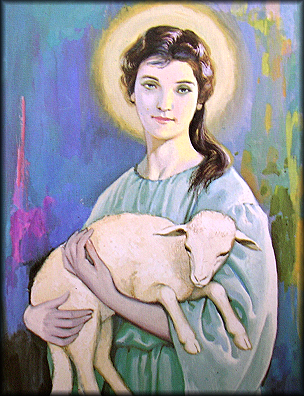
Showing posts with label Lives of Saints. Show all posts

Wednesday, February 6, 2013

St. Paul Miki and Companions


Paul Miki, a Japanese Jesuit, and his twenty-five companions were martyred in Nagasaki, Japan. They were the first martyrs of East Asia to be canonized. They were killed simultaneouly by being raised on crosses and then stabbed with spears. Their executioners were astounded upon seeing their joy at being associated to the Passion of Christ.

According to the 1962 Missal of Bl. John XXIII the Extraordinary Form of the Roman Rite, today is the feast of St. Titus, whose feast in the Ordinary Form is combined with St. Timothy on January 26. It is also the feast of St. Dorothy, virgin and martyr, in the Extraordinary Form.


St. Paul Miki and Companions
Nagasaki, Japan, is familiar to Americans as the city on which the second atomic bomb was dropped, killing hundreds of thousands. Three and a half centuries before, twenty-six martyrs of Japan were crucified on a hill, now known as the Holy Mountain, overlooking Nagasaki. Among them were priests, brothers and laymen, Franciscans, Jesuits and members of the Secular Franciscan Order; there were catechists, doctors, simple artisans and servants, old men and innocent children—all united in a common faith and love for Jesus and his church.

Brother Paul Miki, a Jesuit and a native of Japan, has become the best known among the martyrs of Japan. While hanging upon a cross Paul Miki preached to the people gathered for the execution: "The sentence of judgment says these men came to Japan from the Philippines, but I did not come from any other country. I am a true Japanese. The only reason for my being killed is that I have taught the doctrine of Christ. I certainly did teach the doctrine of Christ. I thank God it is for this reason I die. I believe that I am telling only the truth before I die. I know you believe me and I want to say to you all once again: Ask Christ to help you to become happy. I obey Christ. After Christ's example I forgive my persecutors. I do not hate them. I ask God to have pity on all, and I hope my blood will fall on my fellow men as a fruitful rain."

When missionaries returned to Japan in the 1860s, at first they found no trace of Christianity. But after establishing themselves they found that thousands of Christians lived around Nagasaki and that they had secretly preserved the faith. Beatified in 1627, the martyrs of Japan were finally canonized in 1862.

— Excerpted from Saint of the Day, Leonard Foley, O.F.M.

Tuesday, February 5, 2013

Saint Aloysius de Gonzaga by Isah Barlis


Introduction to the Life of St. Aloysius Gonzaga:

St. Aloysius Gonzaga was born in Northern Italy, between Brescia and Mantova. His father was a famous condottiere, a mercenary soldier. Saint Aloysius received military training, but his father also provided him with an excellent classical education, sending him and his brother Ridolfo to Florence to study while serving at the court of Francesco I de Medici.
Quick Facts:

Feast Day: June 21
Type of Feast: Memorial
Readings: Sirach 48:1-14; Psalm 97:1-2, 3-4, 5-6, 7; Matthew 6:7-15 (full text here)
Dates: March 9, 1568 (Castiglione delle Stiviere, Italy)-June 21, 1591 (Rome)
Birth Name: Luigi Gonzaga
Patron of: Youth; students; Jesuit novices; AIDS patients; AIDS caregivers; sufferers of pestilence
Beatification: October 19, 1605, by Pope Paul V
Canonization: December 31, 1726, by Pope Benedict XIII
Prayers: Prayer Commending Oneself to Mary;Prayer to Saint Aloysius Gonzaga, Patron of Youth; A Prayer To Be Said by Young Men
The Life of St. Aloysius Gonzaga:


In Florence, Saint Aloysius became ill with a kidney disease, and, during his recovery, he devoted himself to prayer and the study of the lives of the saints. At the age of 12, he returned to his father's castle, where he met the great saint and cardinal Charles Borromeo. Aloysius had not yet received his First Communion, so the cardinal administered it to him. Shortly thereafter, Saint Aloysius conceived of the idea of joining the Jesuits and becoming a missionary.


His father was adamantly opposed to the idea, both because he wanted his son to follow in his footsteps as a condottiere, and because, by becoming a Jesuit, Aloysius would give up all rights to inheritance. When it became clear that the boy was intent on being a priest, his family tried to convince him to become a secular priest and, later, a bishop, so that he could receive his inheritance. Saint Aloysius, however, was not to be swayed, and his father finally relented. At the age of 17, he was accepted into the Jesuit novitiate in Rome; at the age of 19, he took vows of chastity, poverty, and obedience. While he was ordained a deacon at the age of 20, he never became a priest.


In 1590, Saint Aloysius, suffering from his kidney problems and other ailments, received a vision of the Archangel Gabriel, who told him that he would die within a year. When a plague broke out in Rome in 1591, Saint Aloysius volunteered to work with plague victims, and he contracted the disease in March. He received the Sacrament of the Anointing of the Sick and recovered, but, in another vision, he was told that would die on June 21, the octave day of the Feast of Corpus Christi that year. His confessor, St. Robert Cardinal Bellarmine, administered Last Rites, and Saint Aloysius died shortly before midnight.


Pious legend has it that Saint Aloysius's first words were the Holy Names of Jesus and Mary, and his last word was the Holy Name of Jesus.


SOURCE: http://catholicism.about.com/od/thesaints/p/Saint_Aloysius.htm

Thursday, January 31, 2013

Saint John Bosco


Feastday: January 31
1815 - 1888

What do dreams have to with prayer? Aren't they just random images of our mind?

In 1867 Pope Pius IX was upset with John Bosco because he wouldn't take his dreams seriously enough. Nine years earlier when Pope Pius IX met with the future saint who worked with neglected boys, he learned of the dreams that John had been having since the age of nine, dreams that had revealed God'swill for John's life. So Pius IX had made a request, "Write down these dreams and everything else you have told me, minutely and in their natural sense." Pius IX saw John's dreams as a legacy for those John worked with and as aninspiration for those he ministered to.

Despite Scripture evidence and Church tradition respecting dreams, John had encountered skepticism when he had his first dream at the age of nine. The young Bosco dreamed that he was in a field with a crowd of children. The childrenstarted cursing and misbehaving. John jumped into the crowd to try to stop them -- by fighting and shouting. Suddenly a man with a face filled with light appeared dressed in a white flowing mantle. The man called John over and made him leader of the boys. John was stunned at being put in charge of these unruly gang. The man said, "You will have to win these friends of yours not with blows but with gentleness and kindness." As adults, most of us would be reluctant to take on such a mission -- and nine year old Johnwas even less pleased. "I'm just a boy," he argued, "how can you order me to do something that looks impossible." Theman answered, "What seems so impossible you must achieve by being obedient and acquiring knowledge." Thenthe boys turned into the wild animals they had been acting like. The man told John that this is the field of John'slife work. Once John changed and grew in humility, faithfulness, and strength, he would see a change in the children -- a change that the man now demonstrated. The wild animals suddenly turned into gentle lambs.

When John told his family about his dream, his brothers just laughed at him. Everyone had a different interpretation of what it meant: he would become a shepherd, a priest, a gang leader. His own grandmother echoed the sage advice we have heard through the years, "You mustn't pay any attention to dreams." John said, "I felt the same way about it, yet I could never get that dream out of my head."

Eventually that first dream led him to minister to poor and neglected boys, to use the love and guidance that seemed so impossible at age nine to lead them to faithful and fulfilled lives. He started out by learning how to juggle and do tricks to catch the attention of the children. Once he had their attention he would teach them and take them to Mass. It wasn't always easy -- few people wanted a crowd of loud, bedraggled boys hanging around. And he had so little money and help that people thought he was crazy. Priests who promised to help would get frustrated and leave.

Two "friends" even tried to commit him to an institution for the mentally ill. They brought a carriage and were planning to trick him into coming with him. But instead of getting in, John said, "After you" and politely let them go ahead. When his friends were in the carriage he slammed the door and told the drive to take off as fast as he could go!

Through it all he found encouragement and support through his dreams. In one dream, Mary led him into a beautiful garden. There were roses everywhere, crowding the ground with their blooms and the air with their scent. He was told to take off his shoes and walk along a path through a rose arbor. Before he had walked more than a few steps, his naked feet were cut and bleeding from the thorns. When he said he would have to wear shoes or turn back, Mary told him to put on sturdy shoes. As he stepped forward a second time, he was followed by helpers. But the walls of the arbor closed on him, the roof sank lower and the roses crept onto the path. Thorns caught at him from all around. When he pushed them aside he only got more cuts, until he was tangled in thorns. Yet those who watched said, "How lucky Don John is! His path is forever strewn with roses! He hasn't a worry in the world. No troubles at all!" Many of the helpers, who had been expecting an easy journey, turned back, but some stayed with him. Finally he climbed through the roses and thorns to find another incredible garden. A cool breeze soothed his torn skin and healed his wounds.

In his interpretation, the path was his mission, the roses were his charity to the boys, and the thorns were the distractions, the obstacles, and frustrations that would stand in his way. The message of the dream was clear to John: he must keep going, not lose faith in God or his mission, and he would come through to the place he belonged.

Often John acted on his dreams simply by sharing them, sometimes repeating them to several different individuals or groups he thought would be affected by the dream. "Let me tell you about a dream that has absorbed my mind," he would say.

The groups he most often shared with were the boys he helped -- because so many of the dreams involved them. For example, he used several dreams to remind the boys to keep to a good and moral life. In one dream he saw the boys eating bread of four kinds -- tasty rolls, ordinary bread, coarse bread, and moldy bread, which represented the state of the boys' souls. He said he would be glad to talk to any boys who wanted to know which bread they were eating and then proceeded to use the occasion to give them moral guidance.

He died in 1888, at the age of seventy-two. His work lives on in the Salesian order he founded.

In His Footsteps:

John Bosco found God's message in his dreams. If you have some question or problem in your life, askGod to send you an answer or help in a dream. Then write down your dreams. Ask God to help you remember and interpret the dreams that come from God.

Prayer:

Saint John Bosco, you reached out to children whom no one cared for despite ridicule and insults. Help us to care less about the laughter of the world and care more about the joy of the Lord. Amen

Copyright 1996-2000 by Terry Matz. All Rights Reserved.
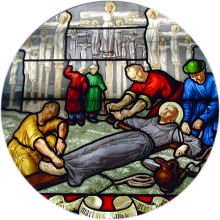
Tuesday, January 22, 2013

Saint Agnes


Saint Agnes was a member of the Roman nobility born c. 291 and raised in a Christian family. She suffered martyrdom at the age of 12 during the reign of the Eastern Roman Emperor Diocletian, on January 21, 304. Agnes' parents were pagans, but she had learned about Jesus and the Gospel from her nurse-slave, with whom she was very close. Phocus, the son of the prefect Roman governor Sempronius, was one of several rich young men who fell in love with Agnes. He brought her rich gifts of jewels, but she rejected his courtship, saying, “I am already the spouse of a Lover much more noble and powerful than you.”

The dejected Phocus later learned that Agnes was a Christian and denounced her to his father. Sempronius questioned her officially, and she freely admitted her faith inJesus. He ordered her to go the temple of Vesta—the virgin goddess of the hearth, home, and family—to offer her a sacrifice, or even to devote herself as one of the Vestal Virgins, but Agnes steadfastly refused any compromise with pagan practice.

Threats of death also did not sway her (some sources indicate that Roman law did not permit the execution of virgins), so the judge threatened her chastity instead. Even this did not frighten her into submission, and Agnes was thus stripped naked and dragged through the streets to a brothel. On the way, as the saint prayed, her hair miraculously grew and covered her body to protect her modesty. At the brothel, she was protected by an angel when several men attempted to have their way with her by force (some versions name Phocus as her attacker). All of those who attempted to rape her were immediately struck blind and/or paralyzed.

Although Agnes remained a virgin, she was now condemned as a witch and led out tied to a stake to be burned. However, the bundle of wood would not burn, whereupon the officer in charge drew his sword and struck off her head (or stabbed her in the throat). The execution reportedly shocked even the bloodthirsty pagan crowd, since Agnes was so young and pure. Thus, her death created a new wave of sympathy for the Christians and brought many to the faith.

A few days after Agnes' death, a girl named Emerentiana was found praying by her tomb. She identified herself as the daughter of Agnes' wet nurse, and was stoned to death after refusing to leave the place and for reprimanding the pagans for killing her foster sister. Emerentiana, too, was later canonized as a saint.